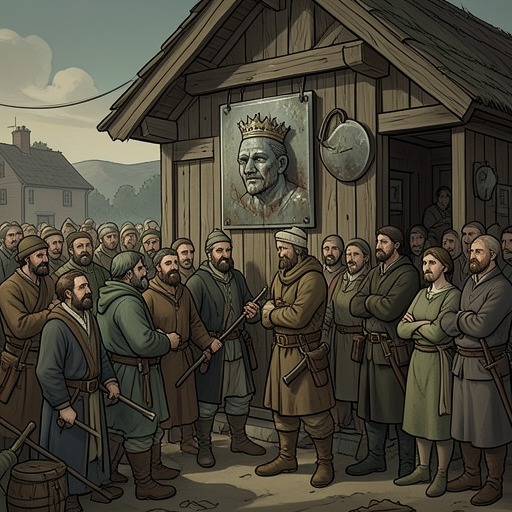
Albert I
William TellAlbert I is the emperor invoked both as a source of legal authority and as a ruler accused of denying an heir his inheritance. Though the Swiss communities had freely sought imperial protection and retained their own laws, the play’s account of Albert’s power is shadowed by the grievances against his rule; his murder near Bruck brings the distant imperial conflict into the drama’s final reckoning.
Imperial Authority and Local Rights
The communities describe their relationship with the empire as freely chosen: they sought its protection, which was freely granted, and point to Emperor Frederick’s charter as a record of that arrangement. Their account distinguishes imperial oversight from direct rule. At home, they governed themselves according to their own laws and ancient usages; the emperor’s stated right was to adjudge the death penalty, which he exercised by appointing a powerful noble as his delegate.
That settlement did not mean complete independence from superior authority. Stauffacher observes that even the freest people have some feudal lord and need a supreme judge to hear appeals in disputes. Albert I therefore stands within a layered political order: imperial authority has a recognized place, but it exists alongside the communities’ customary self-government. The conflict turns in part on whether that limited framework still protects their rights.
Grievances and Resistance
A report of the duke’s complaint gives Albert I a more personal and contested role. The speaker urges the Swiss to seek redress for themselves rather than expect justice from the emperor, alleging that Albert has withheld the rightful inheritance of his brother’s child. The duke, in turn, claims his maternal property. The play presents this accusation in the context of a dispute over inheritance and imperial justice, rather than as a direct scene involving Albert himself.
The Swiss leaders’ response is to discuss recovering their ancient rights and ending the rule of the tyrants and their agents. Fürst states that they will do what necessity requires, but no more, and proposes driving the oppressors out and razing their strongholds. Albert I is not identified as the immediate target of this plan; his significance lies in the imperial order under which the grievances arise and in the expectation that the emperor will not provide redress.
Murder Near Bruck
The news of Albert I’s death arrives during the closing events. Rosselmann announces that the emperor has been murdered, and Stauffacher confirms that King Albert fell near Bruck. He identifies John Mueller of Schaffhausen as the trustworthy messenger who brought the report.
A later account places the killing within sight of the ancient turrets of the House of Habsburg, described as the birthplace of its grandeur. Duke John plunged a dagger into Albert’s throat; Palm ran him through with a lance, and Eschenbach struck his skull. These details make the death a jointly carried out attack, not an act attributed to Duke John alone. The play reports the killing but does not stage it directly in the cited material.
Narrative and Political Significance
Albert I’s role is constructed through reports, legal claims, and the political consequences attached to imperial power. The contrast is sharp: the Swiss remember having freely sought protection, yet a speaker now urges them not to expect justice from the emperor. Their account of local self-rule and customary rights makes the question of imperial authority concrete, while the inheritance allegation connects that question to a grievance involving the emperor’s own family.
Near the end, the text turns to the Bond, naming the communities of Uri, Schwyz, and Unterwalden. Set beside the report of Albert’s death, this reference places the drama’s local political association against the imperial authority that had framed its conflict. The material does not describe Albert’s character or motives beyond the accusation concerning the inheritance; his significance rests on his position in that contested order and on the reported circumstances of his murder.